Industry Insights
Top Stem Cell Applications in 2026: How Stem Cells Are Transforming Medicine
Stem cells are primitive cells found in all multi-cellular organisms. Find out the different uses of stem cells in medicine today in 2026.
Grasp the core value of this article
Point 1
Stem cells are primitive cells found in all multi-cellular organisms. Find out…
Point 2
Stem cells are primitive cells found in all multi-cellular organisms that are…
Point 3
In a developing embryo, stem cells can differentiate into all of the specializ…
Stem cells are primitive cells found in all multi-cellular organisms. Find out the different uses of stem cells in medicine today in 2026.
Stem cells are primitive cells found in all multi-cellular organisms that are characterized by self-renewal and the capacity to differentiate into mature cell types. Stem cell research and experimentation have been underway for over five decades, as stem cells have the unique ability to divide and replicate repeatedly.
In a developing embryo, stem cells can differentiate into all of the specialized embryonic tissues. In adult organisms, stem and progenitor cells act as a repair system for the body, replenishing specialized cells and influencing the microenvironment through paracrine signaling.
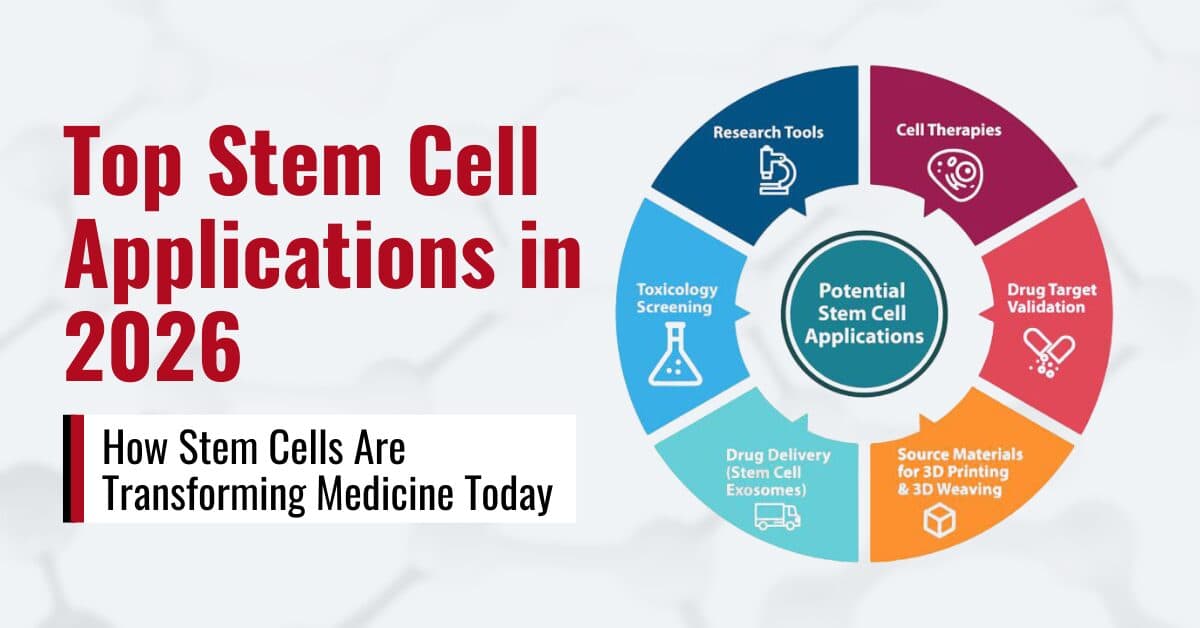
Over the past several decades, six powerful stem cell applications have emerged, including the use of stem cells for:
Research Tools Stem cells serve as invaluable research tools in laboratories for understanding fundamental biological processes, disease mechanisms, and drug discovery. They offer a unique platform for studying cellular differentiation, development, and disease modeling. Researchers can manipulate stem cells to differentiate into various cell types, providing insights into tissue development and pathogenesis. Additionally, stem cells can be genetically modified to create disease models, enabling the study of disease progression and screening potential therapeutics.
Regenerative Medicine Stem cells hold great promise in regenerative medicine for treating a wide range of diseases and injuries. They can differentiate into specialized cell types and replace damaged or dysfunctional cells within the body. Stem cell therapies involve the transplantation of either autologous (patient's own) or allogeneic (donor-derived) stem cells to restore tissue function. These therapies can promote tissue repair, modulate immune responses, and stimulate endogenous regeneration through paracrine signaling and the secretion of growth factors. Examples of stem cell-based therapies include bone marrow transplants for hematopoietic disorders and mesenchymal stem cell injections for orthopedic injuries.
Bioprinting and 3D Weaving Stem cells are integral to the field of bioprinting, where they are used to create bioinks for fabricating complex tissues and organs. By incorporating stem cells into bioink formulations, researchers can print anatomically accurate structures with cellular functionality. This approach enables the fabrication of tissue constructs for transplantation, disease modeling, and drug testing. Stem cells can also be integrated into scaffolds for 3D weaving applications, providing a framework for tissue regeneration and repair. This technology holds promise for creating patient-specific implants and tissue-engineered constructs.
Drug Target Validation and Efficacy Assessment Tissue-specific stem cell-derived cells are valuable tools for validating drug targets and assessing drug efficacy. By generating differentiated cells from stem cells that mimic specific tissues or organs, researchers can screen potential therapeutic compounds in a relevant physiological context. This approach improves the predictive accuracy of preclinical drug testing and helps identify promising drug candidates for further development. Stem cell-based assays can elucidate drug mechanisms of action, identify off-target effects, and accelerate the drug discovery process.
Drug Delivery Stem cells and their secreted extracellular vesicles, known as exosomes, offer unique advantages for drug delivery applications. Stem cells possess inherent homing abilities, allowing them to migrate to sites of injury or disease within the body. By loading therapeutic agents into stem cells or exosomes, researchers can target specific tissues or organs and enhance drug delivery efficiency. Stem cell-based delivery systems offer controlled release kinetics, prolonged circulation times, and reduced immunogenicity compared to conventional drug delivery methods. This approach shows promise for treating various diseases, including cancer, cardiovascular disorders, and neurological conditions.
Toxicology Screening Finally, stem cells offer a versatile platform for evaluating the toxicological effects of drugs and environmental chemicals on biological systems. Traditional methods of toxicity testing often rely on animal models or immortalized cell lines, which may not accurately recapitulate human physiology or predict human responses. Stem cell-based assays provide a more physiologically relevant and human-specific approach to toxicology screening.
Stem cells can be differentiated into various cell types representing different tissues and organs, allowing researchers to create human-relevant models for toxicity testing. For example, induced pluripotent stem cells (iPSCs) can be directed to differentiate into hepatocytes (liver cells), cardiomyocytes (heart muscle cells), neurons (nerve cells), and other cell types affected by toxins.
Stem cell-based assays have the potential to improve regulatory compliance and reduce the reliance on animal testing in toxicology studies. Regulatory agencies, such as the U.S. FDA and the European Medicines Agency (EMA), are increasingly encouraging the use of human-relevant models in toxicity testing to enhance the safety assessment of pharmaceuticals, chemicals, and consumer products.
Continue Exploring
From insights to deep collaboration in research and business
Reading is just the beginning. We invite you to further explore Aoweisi's research capabilities or discover new partnership opportunities.