Industry Insights
Gene-Editing Breakthrough Offers Hope for Complex Genetic Diseases
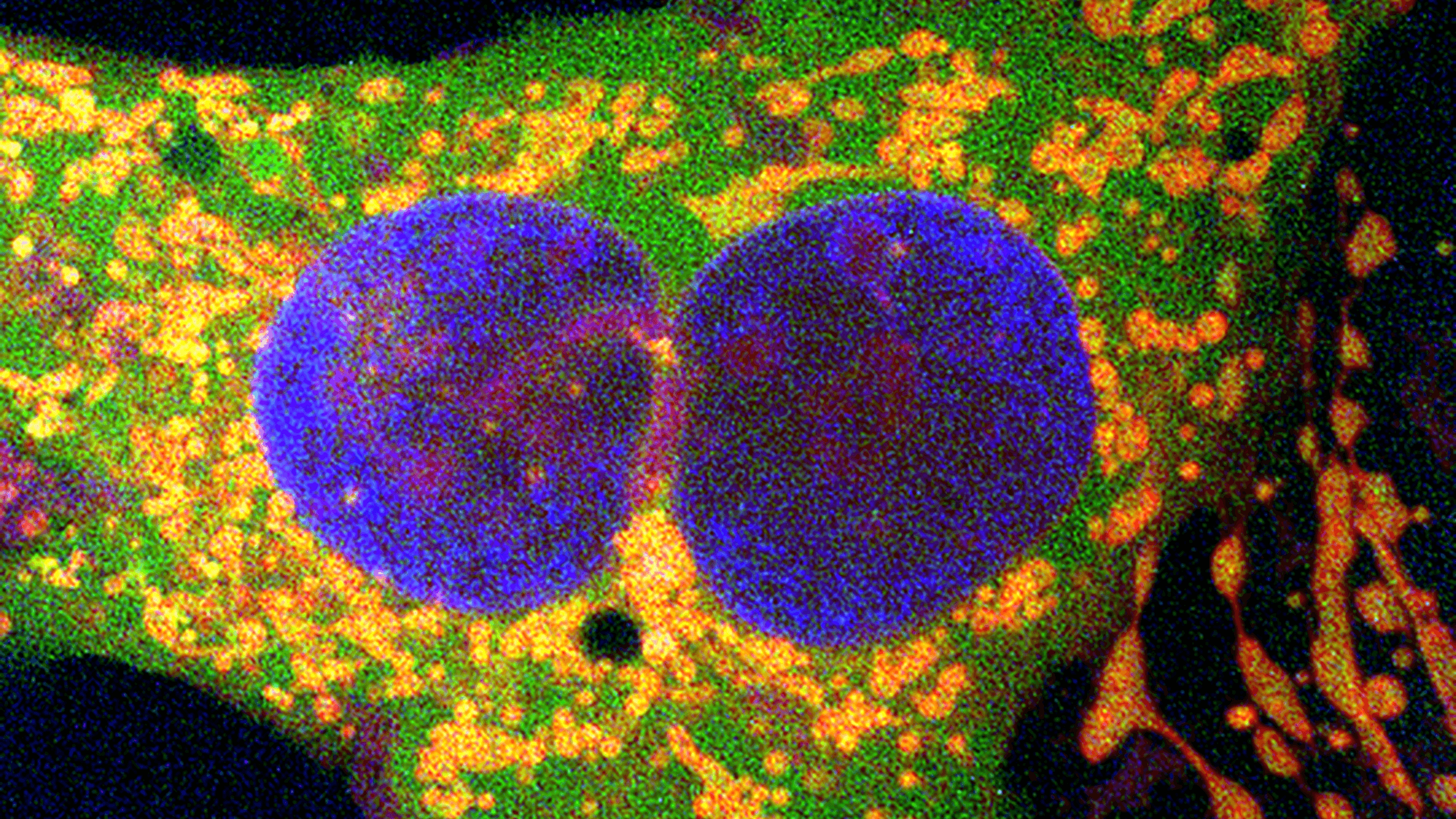
The University of Texas at Austin (UT Austin) research team has announced a landmark advancement in gene-editing technology, marking a significant breakthrough in 2026 for the biotechnology sector. This innovative retron-based gene-editing technique ingeniously repurposes two natural bacterial immune systems to precisely correct large segments of DNA in the human genome. This groundbreaking technology not only significantly surpasses existing gene-editing methods in efficiency and precision but, crucially, demonstrates the ability to simultaneously repair multiple disease-causing mutations, offering revolutionary therapeutic prospects for complex genetic diseases that have long challenged the medical community. Researchers have visually demonstrated human cells treated with the new retron-based gene-editing technology: orange highlights clearly mark successful gene-editing sites, while green highlights show fluorescent protein tags on the surface of mitochondria. (Image credit: You-Chiun Chang/University of Texas at Austin). This discovery undoubtedly injects powerful momentum into the development of precision medicine and personalized gene therapy, signaling a new era where multiple genetic diseases can be effectively addressed.
Grasp the core value of this article
Point 1
The University of Texas at Austin (UT Austin) research team has announced a la…
Point 2
Many genetic disorders, such as cystic fibrosis, hemophilia, and Tay-Sachs dis…
Point 3
The key to this new retron-based gene-editing technology's effective intervent…
The University of Texas at Austin (UT Austin) research team has announced a landmark advancement in gene-editing technology, marking a significant breakthrough in 2026 for the biotechnology sector. This innovative retron-based gene-editing technique ingeniously repurposes two natural bacterial immune systems to precisely correct large segments of DNA in the human genome. This groundbreaking technology not only significantly surpasses existing gene-editing methods in efficiency and precision but, crucially, demonstrates the ability to simultaneously repair multiple disease-causing mutations, offering revolutionary therapeutic prospects for complex genetic diseases that have long challenged the medical community. Researchers have visually demonstrated human cells treated with the new retron-based gene-editing technology: orange highlights clearly mark successful gene-editing sites, while green highlights show fluorescent protein tags on the surface of mitochondria. (Image credit: You-Chiun Chang/University of Texas at Austin). This discovery undoubtedly injects powerful momentum into the development of precision medicine and personalized gene therapy, signaling a new era where multiple genetic diseases can be effectively addressed.
Many genetic disorders, such as cystic fibrosis, hemophilia, and Tay-Sachs disease, involve numerous mutations in a patient's genome. These mutations often exhibit high variability, meaning that even individuals with the same disease may have vastly different combinations of mutations. This complexity poses significant challenges for developing broadly applicable gene therapies, as existing gene-editing methods are often limited to correcting only one or two specific mutations, thus failing to benefit a large number of patients. Addressing this critical need, UT Austin researchers developed their improved gene-editing method. The technique utilizes genetic elements from bacteria called retrons, which naturally protect microbes from viral infections. The research team not only demonstrated the method's high efficiency and precision in simultaneously correcting multiple disease-causing mutations in mammalian cells but also achieved a first by successfully correcting scoliosis-causing mutations in zebrafish embryos, a vertebrate model. This milestone marks the first application of retrons to correct disease-causing mutations in vertebrates, significantly boosting hopes for their use in human gene therapies. Jesse Buffington, a UT Austin graduate student and co-author of the research, noted, "A lot of the existing gene-editing methods are restricted to one or two mutations, which leaves a lot of people behind."
The key to this new retron-based gene-editing technology's effective intervention in complex genetic diseases lies in its unique mechanism. Unlike traditional gene-editing techniques that primarily target single bases or small DNA fragments, this method can replace large segments of defective DNA with healthy gene sequences. This means that a single retron-based gene-editing "package" or vector can repair any combination of mutations within that DNA segment, eliminating the need for customized designs tailored to each individual's specific genetic mutations. "We want to democratize gene therapy by creating off-the-shelf tools that can cure a large group of patients in one shot," said Professor Finkelstein. "That should make it more financially viable to develop and much simpler from a regulatory standpoint because you only need one FDA approval." While other researchers have used retrons for gene editing in mammalian cells, previous methods were highly inefficient, with the best version inserting new DNA into only about 1.5% of targeted cells. The UT Austin method, however, inserts new DNA into approximately 30% of targeted cells, with researchers seeing potential for further improvement. Another benefit is its ability to be introduced into cells as RNA encased in a lipid nanoparticle, a delivery method engineered to mitigate issues associated with other traditional gene-editor delivery systems. The study was co-led by Ilya Finkelstein, a professor of molecular biosciences at UT Austin, and graduate student Jesse Buffington, with partial funding from organizations including Retronix Bio and the Welch Foundation. This collaboration underscores the vital role of industry-academia partnerships in advancing frontier technologies.
In 2026, the global biotechnology sector is experiencing significant breakthroughs in gene therapy, characterized by the rapid development of gene-editing technologies, the expanding scope of therapeutic applications, and the emergence of innovative delivery systems. UT Austin's retron-based gene-editing technology stands as a prominent example within this wave of innovation. It joins foundational technologies like CRISPR-Cas9 in propelling gene therapy to new heights. For instance, CRISPR-Cas9 has made significant clinical strides, with the recent approval of Casgevy® for treating beta-thalassemia and sickle cell disease, demonstrating its growing clinical relevance. The advent of retron technology further expands the boundaries of gene editing, particularly showcasing unique advantages in addressing multi-site, large-segment mutations. These advanced gene-editing methods are shifting gene therapy from treating ultra-rare genetic diseases to a broader range of conditions. Innovations in genomic and epigenomic editing, RNA-based strategies, and advanced delivery systems are offering targeted and potentially curative treatments for diseases once considered incurable. This even includes "N-of-1" gene therapy interventions, which tailor treatment plans for individual patients with unique genetic defects, embodying the ultimate pursuit of precision medicine.
As gene-editing technologies continue to mature, their therapeutic applications are becoming increasingly diverse. In oncology, significant advancements in immunotherapy are being witnessed, including innovative cell therapies targeting tumors. New strategies have been approved for previously hard-to-treat cancers, substantially improving outcomes for solid tumors and hematological malignancies. For example, in January 2026, Siren Biotechnology received FDA clearance to initiate the first-in-human clinical trial for an AAV-based immunogene therapy, signaling gene therapy's increasingly vital role in cancer treatment. UT Austin's retron-based gene-editing technology, with its unique ability to correct large DNA segments and simultaneously repair multiple mutations, holds promise for providing novel solutions for these complex diseases in the future. The UT team is currently applying their approach to develop gene therapies for cystic fibrosis (CF), a disease caused by mutations in the CFTR gene. As researchers anticipate, this versatile "package" capable of replacing large segments of defective DNA will free gene therapy from the limitations of individual genetic differences, thereby "democratizing gene therapy." From ultra-rare genetic diseases to complex conditions like cystic fibrosis and hemophilia, and extending to broader applications in cancer and autoimmune diseases, the continuous breakthroughs in gene-editing technology are reshaping the future of medicine at an unprecedented pace, bringing hope of cures to patients worldwide and ushering in a new era of precision medicine.
Continue Exploring
From insights to deep collaboration in research and business
Reading is just the beginning. We invite you to further explore Aoweisi's research capabilities or discover new partnership opportunities.